
Your Path to the World's Top Independent Schools Starts Here
The ISEE and SSAT are the two primary admission exams for prestigious independent and boarding schools across the United States and worldwide. ISEE & SSAT Prep, powered by Trinity Scholar, gives students from Grade 2 through Grade 11 the preparation, strategies, and expert guidance they need to compete — and succeed!
About
ISEE & SSAT Prep
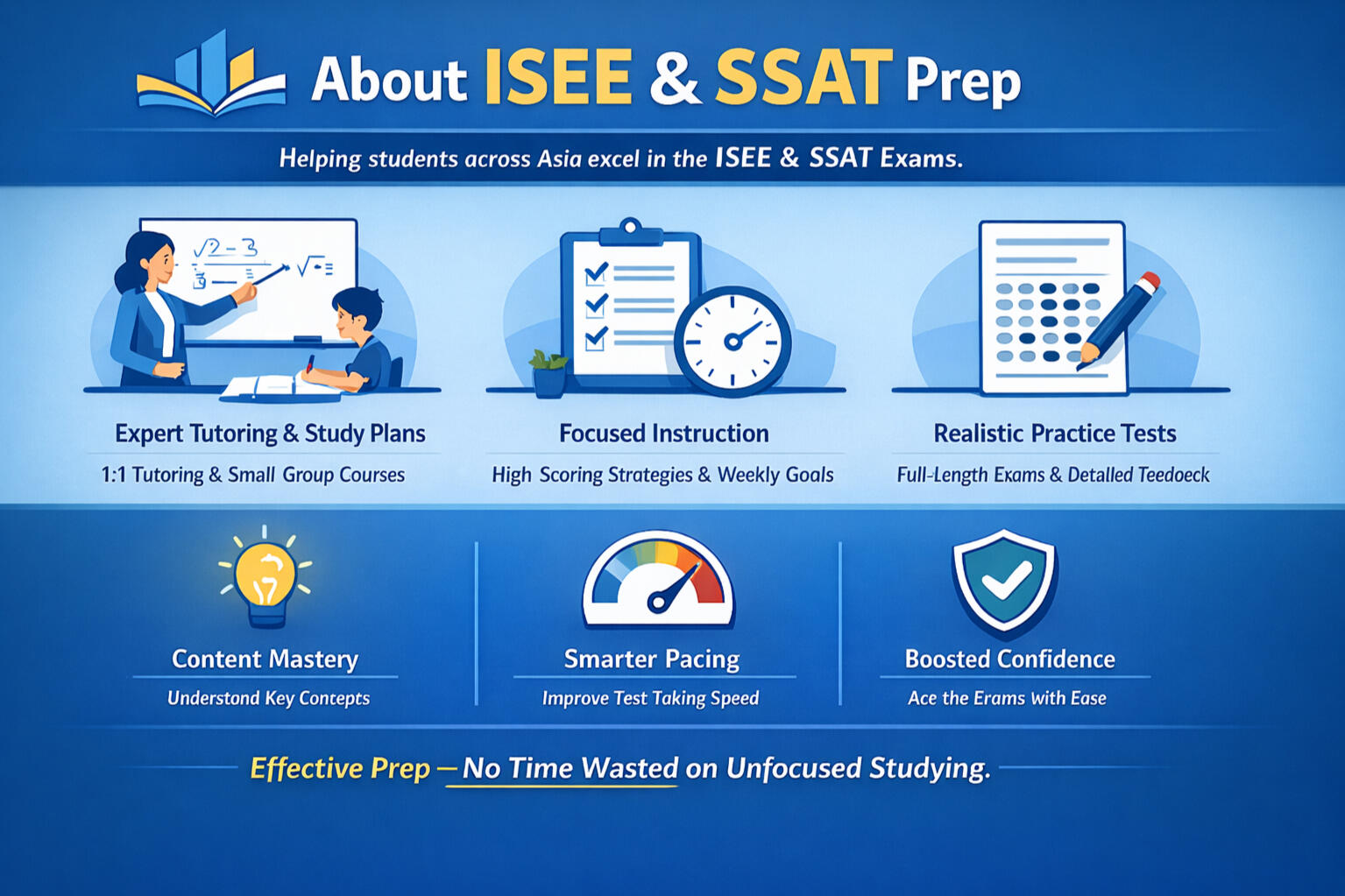
ISEE & SSAT Prep helps students across Asia prepare strategically for the ISEE & SSAT Exams with focused instruction and clear study plans. Our expert tutors break down difficult concepts, teach high-scoring exam techniques, and keep students on track with structured weekly goals. Whether you need 1:1 tutoring, a small-group review course, or full-length practice exams, we combine targeted teaching with realistic test practice and detailed feedback. The result is stronger content mastery, smarter pacing, and more confidence on exam day, without wasting time on unfocused studying.
SERVICES

1:1 ISEE & SSAT Tutoring
Personalized lessons targeting your weak areas, with a custom study plan and score-focused strategies.

Small-Group Review Class
High-impact review sessions with peers, covering key units, common question types, and timing techniques.

Full-Length Practice Exams & Feedback
Realistic timed ISEE & SSAT exams with detailed scoring breakdowns and actionable feedback to improve fast.
ISEE & SSAT Prep
Powered by Trinity Scholar
What are the
ISEE & SSAT Tests?
Both the ISEE and SSAT are standardized admission exams used by independent schools to evaluate applicants. While they serve the same purpose, they are administered by different organizations, follow different formats, and are accepted by different schools. Understanding which test is right for your child is the first step.
ISEE — Independent School Entrance Exam
The ISEE is developed by the Educational Records Bureau (ERB) and is accepted by over 1,200 independent schools worldwide, primarily those following the American academic system. It evaluates each applicant's reasoning and achievement skills relative to other students in the same grade.
Test Levels:
| Level | Applies to Students Currently In | Applying for Entry to |
|---|---|---|
| Primary 2 | Grade 1 | Grade 2 |
| Primary 3 | Grade 2 | Grade 3 |
| Primary 4 | Grade 3 | Grade 4 |
| Lower | Grades 4–5 | Grades 5–6 |
| Middle | Grades 6–7 | Grades 7–8 |
| Upper | Grades 8–11 | Grades 9–12 |
What's on the ISEE? (Middle & Upper Levels)
| Section | Questions | Time |
|---|---|---|
| Verbal Reasoning | 34–40 | 20 minutes |
| Quantitative Reasoning | 37–38 | 35 minutes |
| Reading Comprehension | 25–36 | 25–35 minutes |
| Mathematics Achievement | 30–47 | 30–40 minutes |
| Essay (unscored) | 1 | 30 minutes |
Key ISEE Facts:
Available in both online and paper formats (Lower, Middle, and Upper levels)
No penalty for incorrect answers
Students may take the ISEE once per season (Fall, Winter, Spring/Summer) — up to 3 times per year
Score reports available in 3–5 days (online) or 5–10 days (paper)
Scores reported on a scaled score of 760–940, plus percentile rank and stanine
Schools do not see how many times a student has tested, and cannot see other score recipients on your list
ISEE test levels are determined by the applicant's prospective grade level rather than their age
Test Format Note: ISEE test dates and testing center availability vary by location. Contact us for guidance on registration and finding the right test center for your child.
SSAT — Secondary School Admission Test
The SSAT is administered by the Enrollment Management Association and is accepted by many leading independent schools in the U.S., Canada, and internationally. It measures verbal, math, and reading skills needed for success in an independent school environment.
Test Levels:
| Level | Currently In Grade | Applying for Entry to |
|---|---|---|
| Elemetary | Grades 3-4 | Grades 4-5 |
| Middle | Grades 5-7 | Grades 6-8 |
| Upper | Grades 8–11 | Grades 9–12 |
What's on the SSAT? (Middle & Upper Levels)
| Section | Questions | Time |
|---|---|---|
| Writing Sample (unscored) | 1 | 25 minutes |
| Quantitative 1 | 25 | 30 minutes |
| Reading | 40 | 40 minutes |
| Verbal | 60 | 30 minutes |
| Quantitative 2 | 25 | 30 minutes |
| Experimental (unscored) | 16 | 15 minutes |
| Total | 167 | 3 hrs 5 mins |
Key SSAT Facts:
Middle & Upper Level: no limit on Standard test attempts within a testing year (August 1–July 31); Flex test allowed once per year
Schools do not see how many times a student has taken the test
You control which score reports are sent — and to how many schools
Scores released within approximately two weeks of the test date
No penalty for incorrect answers at the Elementary level; a ¼-point deduction per wrong answer at Middle and Upper levels
SSAT level is determined by the student's current grade level at the time of testing.
Test Format Note: SSAT testing formats and availability differ by region. Digital testing is available at authorized Prometric centers; paper-based options vary. Contact us for the most current information on test formats and registration in your area.
Concentrate on your prep, and let us handle the rest!
Sign up with us now!
ISEE & SSAT Prep
Powered by Trinity Scholar
Why it Matters?
The Gateway to Elite Independent Schools
Whether your child is applying to a prestigious day school, a U.S. boarding school, or an international school following the American curriculum, a strong ISEE or SSAT score is one of the most important components of their application.
These scores are used by schools you know — Both the ISEE and SSAT are accepted by top independent schools worldwide — including internationally recognized institutions such as Taipei American School. Admission officers use these results to compare applicants from different educational backgrounds on a level playing field.
It's not just about academics — A strong exam score signals that a student is prepared for the rigorous academic environment of an independent school — in critical reading, logical reasoning, and mathematical thinking. It complements the rest of the application: grades, recommendations, interviews, and essays.
Scores give students visibility — Because these exams compare students against a national and international applicant pool, a high percentile rank makes your child stand out — especially for students applying from non-U.S. school systems.
Starting early creates an advantage — Unlike college entrance exams, K-12 admission tests can be taken as early as Grade 1 (ISEE Primary). Beginning preparation early gives students more attempts, reduces pressure, and builds long-term academic confidence.
Score Benchmarks
For both exams, schools look at percentile ranks in context. What matters is how a student's score compares to other applicants to the same school — not just a raw number. Research the typical admitted student profile for each school on your target list.
| Exam | Score Scale |
|---|---|
| ISEE | Scaled Score: 760–940 per section; Stanines 1–9 |
| SSAT | Upper: 500–800 per section (1500–2400 Total) |
Same Goal. Different Tests. Choose Strategically.
Both the ISEE and SSAT are accepted by most major independent schools, but they are not identical. Understanding the key differences helps families make a more informed, strategic choice.
| Feature | ISEE | SSAT |
|---|---|---|
| Administered by | Educational Records Bureau (ERB) | Enrollment Management Association |
| Grade Range | Grades 1–11 (applying to Gr. 2–12) | Grades 3–11 (applying to Gr. 4–12) |
| Test Format | Online or paper | Digital (Prometric) or paper (varies by region) |
| Guessing Penalty | No penalty at any level | ¼ point deducted per wrong answer (Middle & Upper) |
| Attempts Allowed | Once per season (up to 3×/year) | Unlimited Standard tests per year (Middle/Upper) |
| Verbal Section | Vocabulary + sentence completion | Analogies + synonyms |
| Math Section | Quantitative reasoning + math achievement | Two quantitative sections |
| Essay | Unscored; sent to schools | Unscored; sent to schools |
| Score Reporting | You choose which scores to send | You choose which scores and which schools |
| School Visibility | Schools don't see attempt count | Schools don't see attempt count |
How to Decide
There is no universally "better" test — the right choice depends on your child's strengths and your target school list. Here are the most useful filters:
Check your target schools first. Most accept both, but some prefer or require one over the other. Always verify with the admission office.
Consider the guessing penalty. The ISEE has no guessing penalty at any level, making it more forgiving for students who find pacing difficult. The SSAT deducts points for wrong answers at the Middle and Upper levels, so strategy matters more.
Look at the verbal format. SSAT verbal questions use analogies, which require a different kind of reasoning than the ISEE's sentence completion format. Students with strong pattern-recognition skills often prefer the SSAT verbal section.
Consider attempt flexibility. The SSAT allows unlimited Standard test attempts per year at the Middle and Upper levels, giving students more opportunities to improve. The ISEE limits attempts to once per season.
Not sure which test to choose? Trinity Scholar offers diagnostic consultations to help identify which exam format best aligns with your child's strengths and target schools. Contact us to get started.
Concentrate on your prep, and let us handle the rest!
Sign up with us now!
ISEE & SSAT Prep
Powered by Trinity Scholar
How to Strategically Prepare for your ISEE or SSAT Test?
Prepare Smart. Start Early. Build Confidence.
When to Start
The earlier, the better. For students applying to schools that require the ISEE Primary, preparation can begin as early as Grade 1. For Middle and Upper level applicants, we recommend starting preparation at least 3–6 months before the target test date. This gives students time to complete a full diagnostic, identify weak areas, and run multiple timed practice sessions before sitting for the real exam.
Understand the Format Before Anything Else
One of the most common preparation mistakes is jumping into content review before understanding the structure of the test. Before studying any material, students should:
Take a full-length official practice test under timed conditions
Review the score report to identify which sections and question types need the most work
Understand the scoring rules for their specific test and level (especially the guessing penalty on the SSAT)
Score Improvement: Verbal & Reading
Both the ISEE and SSAT place significant emphasis on vocabulary and reading comprehension. For students whose first language is not English, this is typically the most challenging area.
Build vocabulary systematically. Both exams test high-level academic vocabulary. Flashcard systems and word-in-context reading are the two most effective approaches. Cramming word lists alone is not enough — students need to see words in use.
Read regularly in English. Magazines, news articles, short stories, and academic texts all build the reading fluency and comprehension these exams reward.
Practice under timed conditions. Time management is one of the biggest hurdles. Regular timed practice builds pacing instincts and reduces test-day anxiety.
Analyze every mistake. After each practice session, review every wrong answer. Determine whether it was a vocabulary gap, a comprehension error, or a careless mistake — then target that specific weakness.
Score Improvement: Math
Take full-length timed practice tests frequently. This builds familiarity with question phrasing and trains the kind of pacing needed across both quantitative sections.
Identify and close specific gaps. Whether it's fractions, algebra, or data interpretation, pinpoint exactly which topics are weak and focus practice there.
Re-solve before reviewing. Attempt missed questions again before reading the explanation. Active recall reinforces understanding far more than passive review.
Ask questions until the concept is fully clear. Partial understanding of a math concept leads to repeated errors. Pursue full mastery of every topic that appears.
Essay / Writing Sample
Neither the ISEE nor SSAT scores the essay, but both send it directly to schools. Admissions officers do read it.
A well-organized, clearly written essay demonstrates maturity and communication skills — qualities independent schools value highly.
Read high-scoring sample essays to understand what structure and development look like at a strong level.
Practice writing to both creative and traditional prompts, as both exams offer a choice.
Have an experienced teacher or instructor review drafts and give structured feedback.
Test-Day Checklist
| ____ | ISEE | SSAT |
|---|---|---|
| What to bring | Verification Letter, student photo ID, parent/guardian ID (Prometric), snack in clear bag | Admission Ticket, #2 pencils, snack in clear bag, photo ID (recommended) |
| Calculators | Not permitted (unless approved accommodation) | Not permitted |
| Electronics | Not permitted | Not permitted; phones must be off |
| Arrive | Early — allow time for check-in | 30–45 minutes before start time |
| Snacks | Allowed during breaks only | Allowed during breaks only |
Concentrate on your prep, and let us handle the rest!
Sign up with us now!
ISEE & SSAT Prep
Powered by Trinity Scholar
FAQ
ISEE & SSAT Frequently Asked Questions
1: What is the difference between the ISEE and the SSAT?
Both are standardized admission exams for independent schools, but they are run by different organizations and have key differences in format, scoring, and attempt limits. The ISEE is offered by the ERB and has no guessing penalty; the SSAT is offered by the Enrollment Management Association and deducts points for wrong answers at the Middle and Upper levels. See the full comparison in the ISEE vs. SSAT2: Which test should my child take?
Most schools accept both. The best choice depends on your child's strengths and your target school list. Students who struggle with pacing may find the ISEE more forgiving due to its no-penalty scoring. Students who are strong with pattern-based reasoning often do well with the SSAT's analogy questions. Contact us for a diagnostic consultation to help decide.3: How many times can my child take each test?
For the ISEE, students may test once per season — Fall, Winter, and Spring/Summer — for a maximum of three times per year.
For the SSAT at the Middle and Upper levels, there is no limit on Standard test attempts within a testing year. Schools do not see how many times a student has taken either test.4: Will schools know how many times my child took the test?
No. Neither the ISEE nor the SSAT includes the number of attempts on the score report sent to schools.5: Do I have to send all my scores to schools?
No. For both exams, families control which scores are sent and to which schools. You are not required to send all attempts. However, verify the policy of each school on your list, as some may request all scores directly.6: How are ISEE scores reported?
ISEE scores are reported as a scaled score (760–940 per section), a percentile rank (comparing the student to other same-grade applicants from the past three years), and a stanine (a 1–9 normalized scale). The unscored essay is sent directly to schools.7: How are SSAT scores reported?
SSAT scores are reported as scaled scores per section, a total score, and a percentile rank comparing the student to same-grade/gender students who took the Standard test in the past three years. The unscored writing sample is sent to schools separately.8: When will we receive score results?
ISEE online scores are available within 3–5 days; paper scores within 5–10 days. SSAT scores are typically released within two weeks of the test date via the student's online account.9: Are calculators allowed?
No. Calculators are not permitted on either the ISEE or the SSAT, unless a student has an approved testing accommodation that explicitly allows for one.10: What formats are available — online or paper?
The ISEE is available in both online and paper formats for Lower, Middle, and Upper levels; Primary levels are online only. The SSAT is available digitally at authorized Prometric centers, with paper-based options that vary by region. Contact us for current availability in your area.11: How do I register for these tests?
Both exams require advance registration — walk-in testing is either unavailable or limited. Registration is completed online through each exam's official website. Contact us if you need guidance on finding a test center or navigating the registration process.12: Can the essay affect my child's admission?
The essay is unscored by both organizations, but it is sent directly to every school your child applies to. Admissions officers do read it. A clear, organized essay can meaningfully strengthen an application, while a poorly written one can raise concerns regardless of strong section scores.
ISEE & SSAT Prep
Powered by Trinity Scholar
Let's Find the Right Test
— and the Right Plan.
Whether you are just beginning to explore independent school options or are ready to start focused exam preparation, Trinity Scholar is here to help at every step.
What We Offer:
Diagnostic consultations to determine whether ISEE or SSAT is the better fit
Personalized study plans built around your child's grade level and target schools
1-on-1 tutoring with experienced instructors
Small group classes tailored to the specific test and level
Full-length practice tests that replicate official exam conditions
Registration assistance and test center guidance
Contact us
Call: +886-2-2771-6002
Email: [email protected]
Line: @TrinityScholar
ISEE & SSAT Prep
Powered by Trinity Scholar